class: center, middle, inverse, title-slide .title[ # Decision Analytic Support in Non-Cooperative Sequential Games ] .author[ ### Roi Naveiro, Tahir Ekin, Aberto Torres, David Ríos ] .date[ ### <a href="mailto:roi.naveiro@icmat.es" class="email">roi.naveiro@icmat.es</a> | Inst. of Mathematical Sciences (ICMAT-CSIC) Madrid | ADA 2022 ] --- # Sequential Defense Attack Games <center>  </center> * Gaining Importance due to the raise of AML! * Classical Decision Makers, Humans: **discrete** and **low dimensional** decision spaces. * New Decision Makers, Algorithms: **continuous** and **high dimensional** decision spaces. --- # New Solution techniques * Forget about (general) analytic solutions! * Must work with uncertain outcomes * Must acknowledge uncertainty about adversary * We propose a **Simulation-based** solution approach: * Solves general security games, with uncertain outcomes, complete and incomplete information * Explain it for Sequential Defend-Attack games under incomplete information --- # Seq. Games with Uncertain Outcomes <center>  </center> --- # Game theoretic approach * **Common Knowledge Assumtion**: the Defender knows the Attacker's probabilities and utilities. * Compute expected utilities. `\begin{equation*} \psi_A (a,d) = \int u_A (a, \theta )\, p_A(\theta \vert d,a)\, \mathop{}\! \mathrm{d} \theta \quad\text{and}\quad \psi_D (d,a) = \int u_D (d, \theta )\, p_D(\theta \vert d,a) \mathop{}\! \mathrm{d} \theta. \end{equation*}` -- * Attacker's best response to defense `\(d\)` `\begin{equation} a^*(d) = \arg\max_{a \in \mathcal{A}}\, \psi_A(d,a) \end{equation}` -- * Defender's optimal action `\begin{equation*} d^*_\text{GT} = \arg\max_{d \in \mathcal{D}}\, \psi_D(d, a^*(d)). \end{equation*}` * `\(\left[ d^*_\text{GT},\, a^*(d^*_\text{GT}) \right]\)` is a **Nash equilibrium** and a **sub-game perfect equilibrium**. --- # ARA approach * Weaken Common Knowledge Assumption: the Defender **does not know** `\((u_A, p_A)\)`. * We need `\(p_D(a \vert d)\)`! * Then, `\(d^*_{\text{ARA}} = \arg\max_{d \in \mathcal{D}} \psi_D(d)\)`, where `\begin{equation*} \psi_D(d) = \int \psi_D(a,d)\, p_D(a \vert d) \mathop{}\! \mathrm{d}a = \int \left[ \int u_D (d, \theta)\, p_D(\theta \vert d,a) \mathop{}\! \mathrm{d} \theta \right]\, p_D(a \vert d) \mathop{}\! \mathrm{d} a , \end{equation*}` --- # ARA approach * To elicitate `\(p_D(a \vert d)\)`, Defender analyses Attacker's problem. * Model uncertainty about `\((u_A, p_A)\)` through distribution `\(F = (U_A, P_A)\)`. * Induces distribution over attacker's expected utility `\(\Psi_A(a,d) = \int U_A(a,\theta) P_A(\theta \vert a,d) \mathop{}\! \mathrm{d} \theta\)`. * And `\(A^*(d) = \arg\max_{x \in \mathcal{A}} \Psi_A(x,d)\)` * Then, `\begin{equation} p_D(A \leq a \vert d) = \mathbb{P}_F \left[ A^*(d) \leq a \right], \end{equation}` --- # ARA approach * In practice, discretize decision set * Draw `\(J\)` samples `\(\left\{\left( P_A^i, U_A^i\right) \right\}_{i=1}^J\)` from `\(F\)` and `\begin{equation} \hat{p}_D(a \vert d) \approx \frac{\# \{ a = \arg\max_{x \in \mathcal{A}} \, \Psi_A^i(x,d) \}}{J}, \end{equation}` * ARA solution is a **Bayes-Nash Eq.** (in sequential games) --- # MC solution method <center>  </center> * Requires generating `\(\vert \mathcal{D} \vert \times (\vert \mathcal{A} \vert \times Q \times J + P)\)` samples. --- # APS - Idea 1 * Assume we can sample from `\(p_D(d | a)\)` * Max expected utility `$$d^*_{\text{ARA}} = \arg\max_{d} \int \int u_D(d, \theta) \cdot p_D(\theta | d, a) \cdot p_D(d | a) d \theta d a$$` * Define `$$\pi_D(d, a, \theta) \propto u_D(d, \theta) \cdot p_D(\theta | d, a) \cdot p_D(d | a)$$` `\(~\)` * Mode of marginal `\(\pi_D(d)\)` is `\(d^*_{\text{ARA}}\)` ! --- # APS - Idea 2 * Flat expected utilities, complicates mode identification * Define `$$\pi^H_D(d,\theta_1, \dots, \theta_H, a_1, \dots, a_H) \propto \prod_{i=1}^H u_D(d, \theta_i) \cdot p_D(\theta_i | d , a_i) \cdot p_D(a_i | d)$$` * Marginal more peaked around max! `$$\pi^H_D(d) \propto \left[ \int \int u_D(d, \theta) \cdot p_D(\theta | d, a) \cdot p_D(d | a) d \theta d a \right]^H$$` --- # APS - Implementation * Sample from `\(\pi(d,\theta_1, \theta_2, \dots, \theta_H, a_1, \dots, a_H)\)` using MCMC. * Find mode of `\(d\)` samples. -- 1. State of the Markov chain is `\((d, \theta_1, \dots, \theta_H, a_1, \dots, a_H)\)`; 2. `\(\tilde{d} \sim g(\cdot \vert d)\)`; 3. `\(\tilde{a}_i \sim p_D(a \vert \tilde{d})\)` for `\(i = 1, \dots, H\)`; 3. `\(\tilde{\theta}_i \sim p_D(\theta \vert \tilde{d}, \tilde{a}_i)\)` for `\(i = 1, \dots, H\)`; 4. Accept `\(\tilde{x}, \tilde{\theta}_1, \dots, \tilde{\theta}_H, \tilde{a}_1, \dots \tilde{a}_H\)` with probability $$ \min \left \lbrace 1, \frac{g(d \vert \tilde{d})}{g( \tilde{d} \vert d)} \cdot \prod_{i=1}^H \frac{u_D(\tilde{d}, \tilde{\theta}_i)}{u_D(d, \theta_i )} \right \rbrace $$ 5. Repeat -- * Embed this MCMC within an annealing schedule that increases H! --- # APS for ARA - `\(p_D(a | d )\)` * For given `\(d\)`, random augmented distribution `\(\Pi_A(a, \theta \vert d) \propto U_A(a, \theta ) P_A(\theta \vert d, a)\)`, * Marginal `\(\Pi_A(a \vert d) = \int \Pi_A(a, \theta \vert d) d \theta\)`, proportional to `\(A\)`'s random expected utility `\(\Psi_A(d,a)\)`. * Random optimal attack `\(A^*(d)\)` coincides a.s. with mode of `\(\Pi_A(a \vert d)\)`. * Then: 1. `\(u_A(a, \theta) \sim U_A(a, \theta)\)` and `\(p_A(\theta \vert d, a) \sim P_A(\theta \vert d, a)\)` 2. Build `\(\pi_A(a, \theta \vert d) \propto u_A(a, \theta) p_A(\theta \vert d, a)\)` which is a sample from `\(\Pi_A (a, \theta \vert d)\)`. 3. Find `\(\text{mode}[\pi_A(a \vert d)]\)` which is a sample of `\(A^*(d)\)`, whose distribution is `\(\mathbb{P}_F \left[ A^* (d) \leq a \right] = p_D(a \leq d)\)`. --- # APS vs MC * MC requires `\(\vert \mathcal{D} \vert \times (\vert \mathcal{A} \vert \times Q \times J + P)\)` samples * APS requires at most `\(N \times (2M + 5) + 2M + 4\)` samples * Simple game with continuos decision sets * Several in parallel * Compute min number of samples s.t. 90% solutions coincide with truth (to required precision) <center>  </center> --- # Application <center> 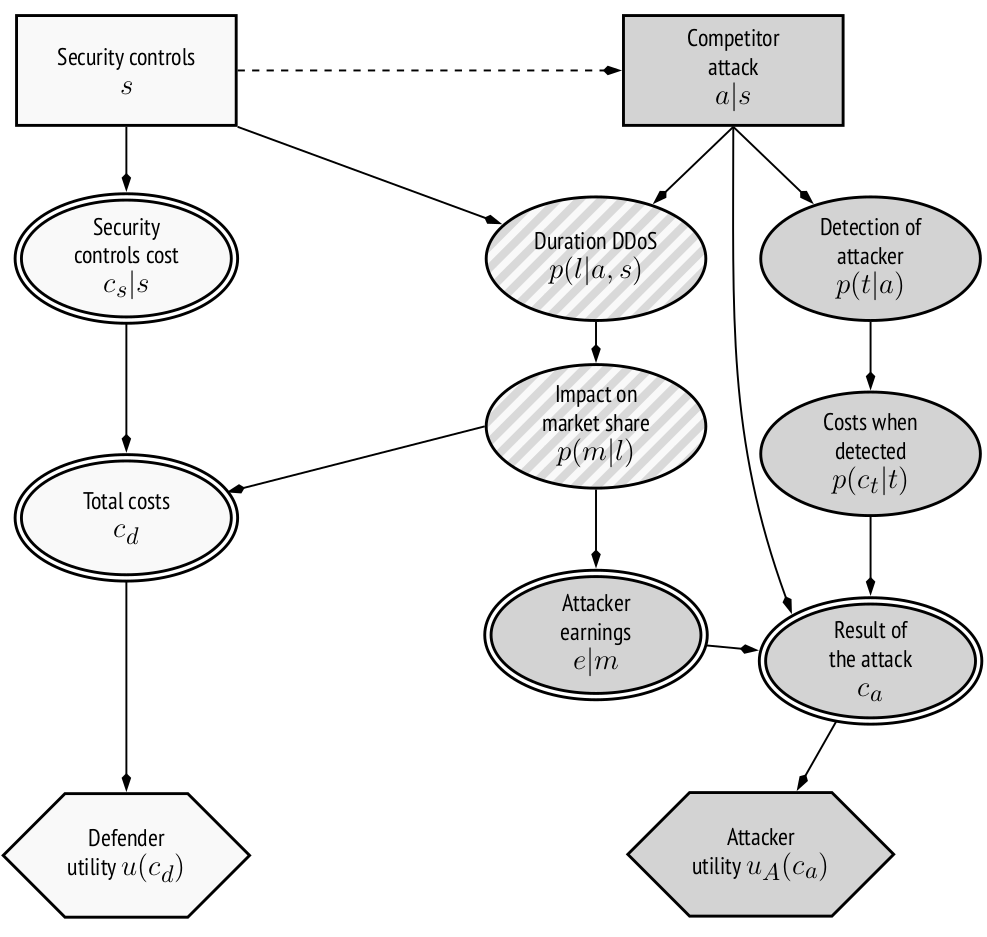 </center> --- # Application * Elicited probability `\(p(a \vert d)\)` for some security controls. <center> 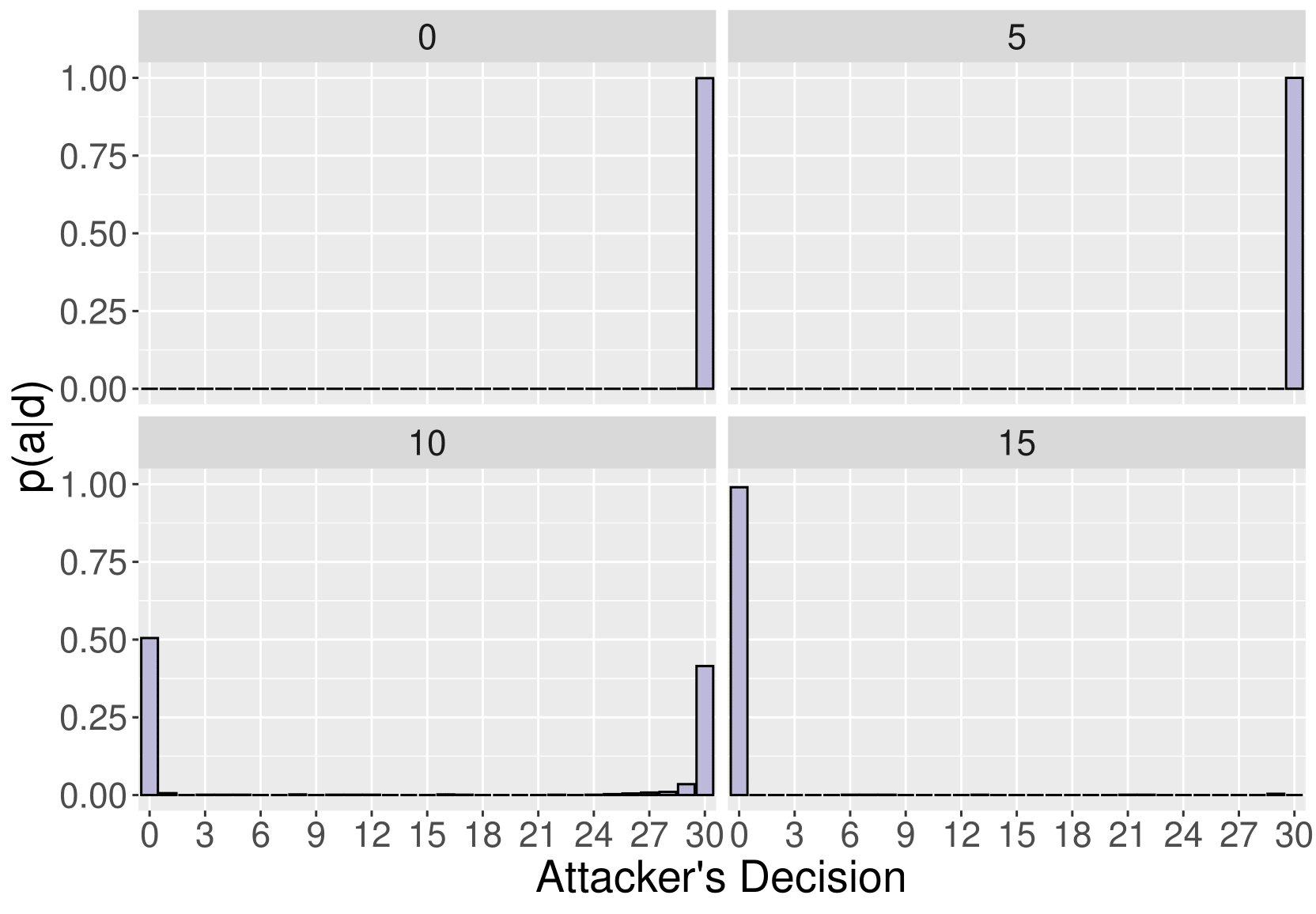 </center> --- # Application * Histogram of samples of security controls. <center> 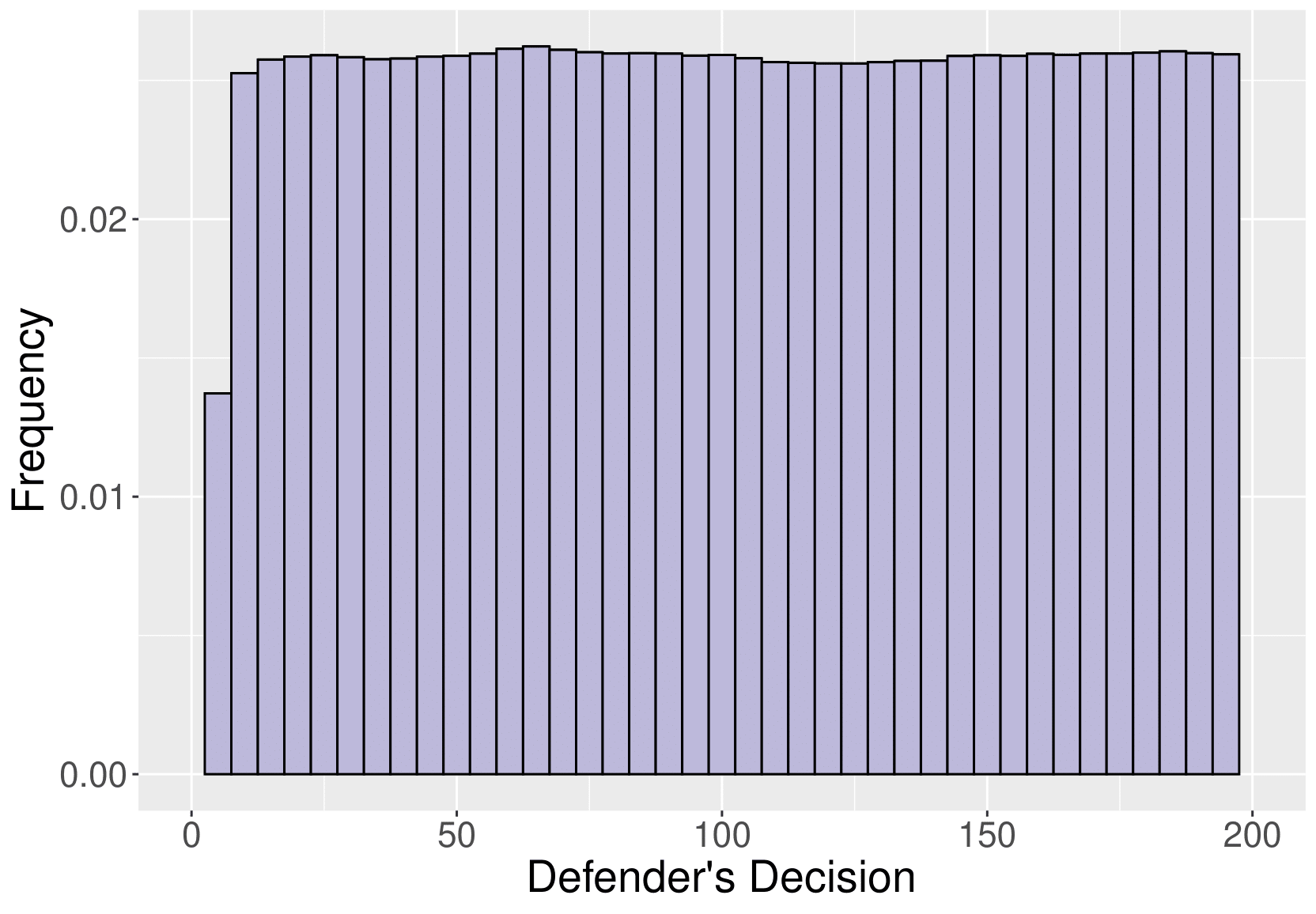 </center> --- # Application - Increasing H <center> 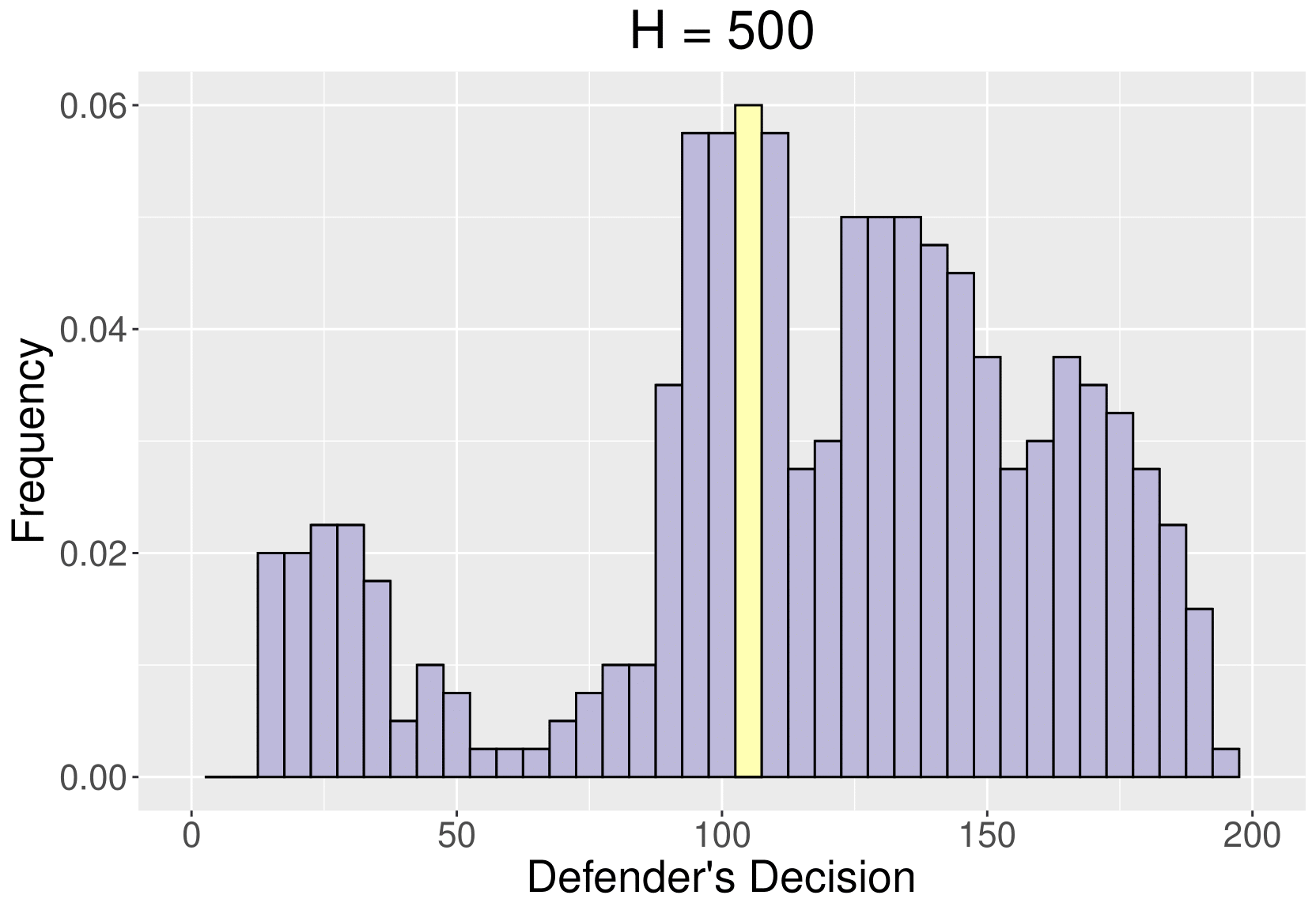 </center> --- # Application - Increasing H <center>  </center> --- # Application - Increasing H <center>  </center> --- # Application - Increasing H <center>  </center> --- # Application - Increasing H <center>  </center> --- # Application - Increasing H <center>  </center> --- # Application - Increasing H <center>  </center> --- # Application - Increasing H <center>  </center> --- # Application - Increasing H <center>  </center> --- # Application - Increasing H <center>  </center> --- # Application - Increasing H <center>  </center> --- # Application - Increasing H <center>  </center> --- # Application - Increasing H <center>  </center> --- # Application - Increasing H <center>  </center> --- # Application - Increasing H <center>  </center> --- # Application - Increasing H <center>  </center> --- # Application - Increasing H <center>  </center> --- # Application - Increasing H <center>  </center> --- # Application - Increasing H <center>  </center> --- # Conclusions * APS for games, both standard and ARA. * APS better when cardinality of decision spaces is big (or spaces are continuous). * Suggested **algorithmic approach** 1. Use MC for broad exploration of decision space. 2. Use APS within regions of interest to get refined solutions. --- class: middle, center, inverse # Thank you!! **Website** <span style="color:cyan">roinaveiro.github.io/</span> **Email** <span style="color:cyan">roi.naveiro@icmat.es</span> **GitHub** <span style="color:cyan">github.com/roinaveiro</span>